
What is a rectifier?
11.08.2025


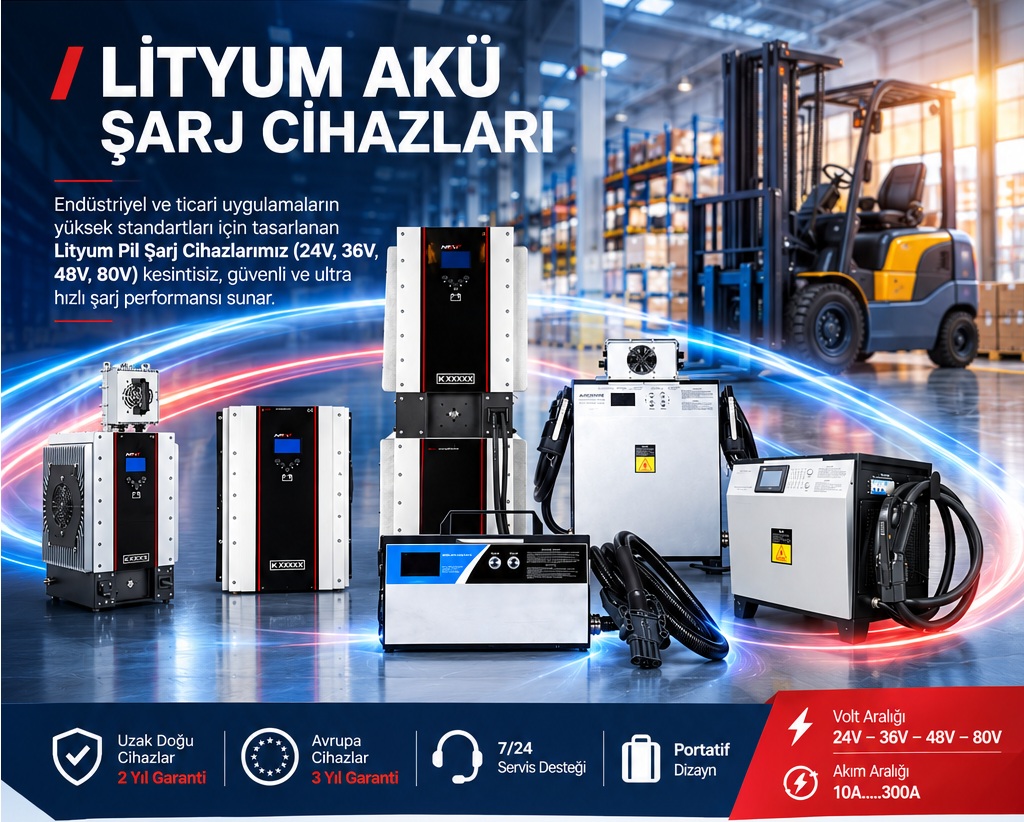
Choosing a Lithium Battery Charger: BMS Compatibility, the Right Power Rating and Safe Charging
Lithium battery technology is increasingly preferred in industrial applications such as electric forklifts, pallet trucks, industrial cleaning machines and autonomous mobile robots. High energy density, fast charging and, under the right operating conditions, a long service life make lithium batteries an important part of modern energy systems.
However, getting the performance you expect from lithium technology takes more than choosing the right battery. Using a compatible lithium battery charger with the right technical specifications is just as important.
So what should you look for when choosing a lithium battery charger? Why does BMS communication matter? How should voltage and current values be determined?
In this article, we at TLC Enerji cover the key criteria for choosing a lithium battery charger for industrial applications.
What Is a Lithium Battery Charger?
A lithium battery charger is a power electronics device that charges lithium-ion batteries within the electrical limits set by the manufacturer, and is matched to the battery chemistry and its intended use.
These devices convert mains electricity into the DC current and voltage the battery needs. In more advanced models, the charging process is managed by microprocessor-controlled algorithms, and communication with the battery management system (BMS) can be supported.
In industrial use, choosing the right charger helps to:
What matters is not just that the charger can deliver power to the battery, but that it can operate in line with the battery’s technical requirements.
1. Why Do Voltage and Amperage Matter When Choosing a Lithium Battery Charger?
The first two parameters to evaluate are output voltage and output current (amperage).
Choosing the voltage
The charger’s output voltage must match the nominal voltage of the battery pack and the charging voltage requirements specified by the battery manufacturer.
Industrial applications use a range of battery systems, such as 24V, 36V, 48V and 80V. However, two lithium batteries with the same nominal voltage may not use the same charging parameters.
For this reason, the decision should not be based only on the voltage printed on the battery. The cell chemistry, the number of cells in series and the manufacturer’s charging specifications should also be checked.
Choosing the amperage
The charging current should be determined based on the battery’s capacity and its permitted charge rate.
For example, a charger with a 40A output could be considered for a 48V, 200Ah battery. However, this does not mean that 40A is suitable for every 200Ah battery. The final choice must be based on the charging current permitted by the battery manufacturer and on the system requirements.
Choosing a charger with too little current capacity can lengthen charging times. Choosing one with too much can risk exceeding the battery’s permitted charging limits.
The right approach: Match the voltage to the battery system, and determine the charging current based on battery capacity, the manufacturer’s limits and your operating schedule.
2. BMS Compatibility: A Critical Criterion in Lithium Battery Charging
A BMS (Battery Management System) monitors key parameters of a lithium battery pack, such as voltage, temperature and current. Depending on the system design, it can also limit or control charging and discharging.
Compatibility between the charger and the BMS is especially important in industrial lithium battery systems.
CAN bus and CANopen communication
Some lithium batteries communicate with the charger over protocols such as CAN bus or CANopen. However, having the same communication interface does not mean two devices are automatically compatible.
Message structure, communication speed, data definitions and control logic must also be compatible.
In systems that support BMS communication, the charger can, depending on the design, operate according to the current or voltage limits sent by the BMS. This helps ensure that charging is managed in line with the battery’s requirements.
Before buying a lithium battery charger, the following questions should be answered:
These checks matter most in projects where the battery and the charger come from different manufacturers.
3. Can the Same Charger Be Used for Every Lithium Battery?
No. Not all lithium batteries work with the same charging parameters.
Cell chemistry, pack design, nominal voltage, maximum charging voltage, permitted charging current and BMS features all directly affect the selection process.
For example, two batteries with different cell chemistries may have different charging requirements even if their nominal voltages are similar. A charger that is right for one battery may therefore not give the same result with another.
The battery manufacturer’s technical documentation should be the basis for choosing a charger, and the appropriate charging profile and, where applicable, the communication settings should be verified.
Some chargers also offer different charging programs for different battery types. However, this does not mean every charger is compatible with every lithium battery.
4. Charger Technologies for Industrial Applications
For industrial chargers, energy efficiency, size, weight, protection level and operating conditions are important selection criteria.
High-frequency switch mode technology
Thanks to power electronics technology, switch mode chargers can offer advantages such as a compact design and high efficiency. Features such as PFC (Power Factor Correction) and Soft Start can also help improve power quality and start-up behavior, depending on the design.
Actual efficiency, power factor and electrical performance figures should be checked in the model’s technical documentation.
Robust housing and protection class
The environment in which the charger will be used is a decisive factor in product selection.
Warehouses, logistics centers, outdoor applications and wash-down areas can have different protection requirements. The IP rating indicates resistance to dust and water ingress. However, an IP rating alone does not show that a device is suitable for every environment.
Vibration, impact, temperature, ventilation and mounting conditions should also be taken into account.
On-board and external chargers
External chargers can be placed at a point independent of the battery or vehicle. On-board chargers (OBCs), on the other hand, are solutions that can be mounted on the vehicle itself.
OBC solutions can make things easier in golf carts, electric cleaning machines, AGV/AMR systems and various industrial vehicles. When choosing, the mounting space, weight, cooling, environmental conditions and electrical connections on the vehicle should be considered together.
5. Safety and Protection Features in Lithium Battery Chargers
In industrial applications, safe charging is not ensured by choosing the right voltage and amperage alone.
Depending on the charger’s design, the following protection features can be evaluated:
Keep in mind that these features are not offered to the same extent in every model. The protections you need should be verified in the device’s technical documentation.
In addition, the charger’s compliance with relevant standards, its electrical compatibility with the battery system and correct installation conditions are also important for safe operation.
6. Which Sectors Use Lithium Battery Chargers?
As lithium battery technology becomes more widespread, the need for suitable charging solutions is growing as well.
The main areas of use include:
In every application, the battery’s technical specifications, communication requirements and operating conditions must be evaluated individually.
7. Lithium Battery Charging Solutions Tailored to Your Needs with TLC Enerji
TLC Enerji offers product options for the needs of different applications in the field of industrial battery charging systems.
The K-Next, NEOS and AiPower solutions in our portfolio can be evaluated with different voltage ranges, design options, protection levels and communication capabilities, depending on the technical specifications of the model.
Comparing prices alone is not enough to choose the right product. Battery and charger compatibility, delivery time, warranty terms, technical support and potential service needs also affect the total cost of ownership.
To determine the right solution for your needs, it helps to share the following information:
With this information, it becomes easier to assess the technical requirements and identify suitable product alternatives.
At TLC Enerji, our goal is to help you find charging solutions that suit your operating conditions and technical requirements.
Frequently Asked Questions
Can a regular battery charger be used for a lithium battery?
Only if it has been verified that the charger meets the charging requirements of the lithium battery in question. A charger designed for lead-acid batteries should not be assumed to be compatible with a lithium battery.
Can a lithium battery without BMS communication be charged?
Some lithium battery systems can support charging without communication, according to the charging profile and electrical limits set by the manufacturer. Whether this is appropriate must be determined according to the battery manufacturer’s instructions.
Does a higher-amperage charger charge faster?
Not always. Charging time depends on the battery’s permitted charging current, BMS limits, the charging curve, the state of charge and temperature conditions. A charger with a high current capacity does not by itself guarantee faster charging.
What should be considered when choosing a lithium battery charger for a forklift?
Battery voltage, capacity, permitted charging current, BMS compatibility, connector and pinout, operating environment, protection class and daily usage pattern should be evaluated together.
Why is technical support important when choosing a lithium battery charger?
Incorrect voltage, an unsuitable charging profile or incompatible communication settings can prevent the system from working properly. A technical assessment helps identify the right product and reduces integration problems.
Conclusion
Choosing the right charger is an important step toward getting high performance from lithium battery systems. Besides voltage and amperage, BMS compatibility, the charging profile, protection features and the operating environment should also be evaluated.
Whether it is for forklifts and pallet trucks, electric cleaning machines, golf carts or AGV/AMR systems, the right charging solution can help your business plan its energy infrastructure more efficiently.
Contact TLC Enerji for your lithium battery charger needs. Let’s evaluate product alternatives suited to your application and your battery’s technical specifications together.


